
Monitoring golden flavescence with drones
Introduction
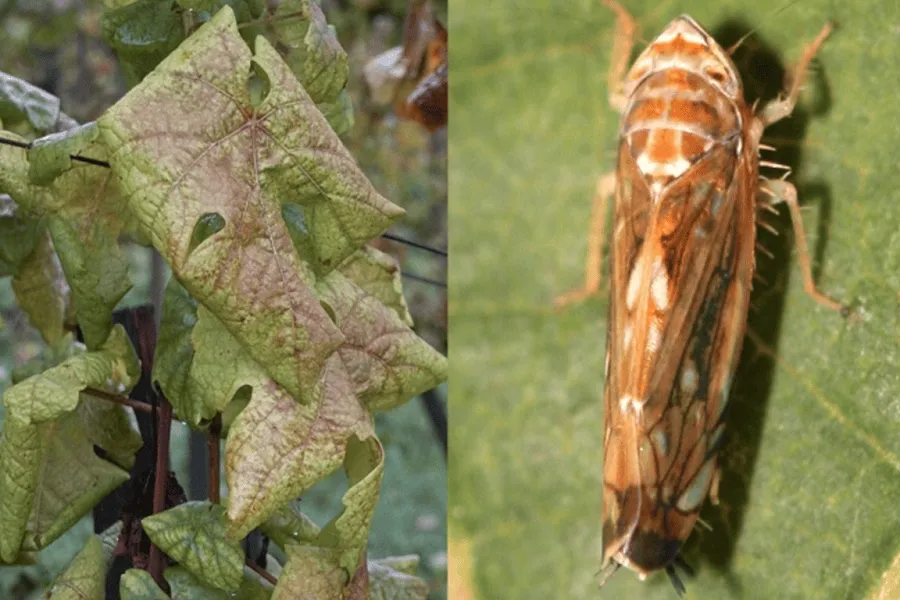
Golden flavescence is a very serious disease affecting grapevines, caused by a phytoplasma that damages the plant’s vascular system. Golden flavescence can spread rapidly through an insect vector, Scaphoideus titanus, a leafhopper that completes its life cycle within the vineyard. By feeding on infected vines, Scaphoideus acquires the phytoplasma and remains infective for its entire life cycle.
This disease is a significant problem for the wine industry, which is why Italian authorities and wine sector operators have adopted various strategies to combat it, including monitoring programmes, the promotion of appropriate agronomic practices and awareness campaigns to involve winegrowers in the fight against the disease.
Mandatory monitoring
Golden flavescence is included among the quarantine pests of concern to the European Union; it is therefore subject to mandatory pest control, pursuant to EU Regulation 2019/2072 of 28 November 2019. Being subject to mandatory control, golden flavescence requires mandatory monitoring in order to identify symptomatic plants and implement disease containment measures.
Monitoring golden flavescence with drones
Monitoring of golden flavescence currently relies on visual observation by qualified operators, who check for characteristic symptoms such as leaf curling, yellowing/reddening and shoot degradation.
Visual monitoring of flavescence by agricultural operators certainly has some drawbacks. Subjectivity of interpretation, limited coverage, diagnostic timelines and visual fatigue are all factors that can affect the effectiveness and accuracy of monitoring. To overcome these drawbacks, automated technologies can be used to improve the efficiency and objectivity of disease monitoring, such as the use of drones.
Researchers at the École d’Ingénieurs de Purpan in France have recently published an article on precisely this subject. The aim of the study was to assess the feasibility of discriminating golden flavescence symptoms in red (Gamay and Duras) and white (Colombard and Sauvignon) cultivars from healthy vegetation using drone-based remotely sensed images (Fig. 1).
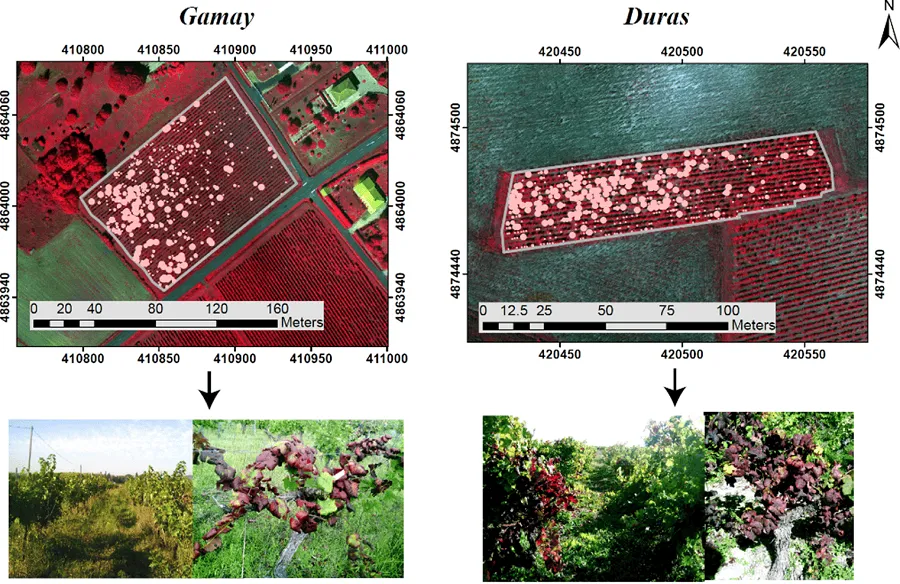
Fig.1: False-colour drone orthophoto of the 2 selected red-berry vineyards (Gamay and Duras) and the location of all infected vines. The size of the pink circles varies according to the severity of the disease. The two images below each orthophoto give an overview of the vineyard and show an example of an infected vine.
Analysis of the results made it possible to discriminate between diseased and healthy grapevines. The best results were recorded for the red varieties, in which, thanks to certain indices (RGI and GRVI), the researchers demonstrated strong discrimination between pixels of diseased and healthy plants. For the white varieties, the results were less significant. The researchers conclude that, taking into account pixel classification error, it is possible to propose an operational golden flavescence mapping technique using drone-based remotely sensed images.
Conclusions
Drone-based monitoring of golden flavescence could offer several advantages in controlling and managing the disease, enabling early detection, timely intervention and better strategic planning to preserve vine health and grape production.
Thanks to its very high spatial resolution and flexible flight planning, drone-based detection of flavescence is of great interest, since symptoms are often distributed in small patches and may only be visible for short periods during the year. Regular drone monitoring would make it possible to detect the signs and symptoms of golden flavescence early, allowing winegrowers to intervene quickly, adopting preventive measures to limit the spread of the disease and minimise damage. Furthermore, compared with traditional monitoring methods, drones can cover larger areas in less time and reach hard-to-access areas, such as steep vineyards or uneven terrain, helping to reduce overall operating costs.
Through systematic, regular monitoring of vineyards over time, it is possible to obtain accurate documentation of vine conditions across the seasons, allowing for a better understanding of disease spread trends and patterns. This information can be useful for long-term strategic planning and the adoption of more effective preventive measures.
To find out more about our drone services, visit the page dedicated to iDrone and contact us for details!