

by Luana Centorame
Share
Introduction
In recent years, viticulture is facing an increasingly complex challenge: to produce high-quality wines efficiently, sustainably and consistently with market demands, while reducing the component of subjectivity in agronomic decisions. In this context, precision agriculture technologies represent a key tool to read and manage the natural variability of the vineyard.
Among the digital solutions currently available, the use of drone vigor maps allows agronomic information to be transformed into field operations. This approach opens up new possibilities, even for a traditionally manual and subjective stage such as selective harvesting, allowing a shift from selection based on visual experience to collection guided by objective, spatialized data.
The case study presented in this paper shows how the integration of remote sensing, vineyard zoning and differentiated harvest management can lead to the production of distinct wines, each an expression of different vegetative-productive conditions in the vineyard.
The case of the Cinciano Farm
Within the Chianti Classico DOCG area lies the Cinciano farm. The estate vineyard covers 28 hectares and is dominated by the Sangiovese grape variety, which covers about 90 percent of the entire vineyard area. The plots, although located in a rather concentrated area, are characterized by a strong variability of soils and altitude. In fact, soils with a strong silty component can be identified at 150 m a.s.l., then moving on to soils rich in marl and clay in the central part, up to 360 m a.s.l. where there is also a good sandy component.
From manual to automated selection
In the past, the harvesting of grapes for the production of Chianti Classico “Gran Selezione” was done through a visual selection of the best bunches. It is evident that this method also brings with it variability due to the subjective evaluation parameters of those who carry out the harvest. To make the evaluation objective, the vigor index, production load and the quanti-qualitative characteristics of the grapes can be related.
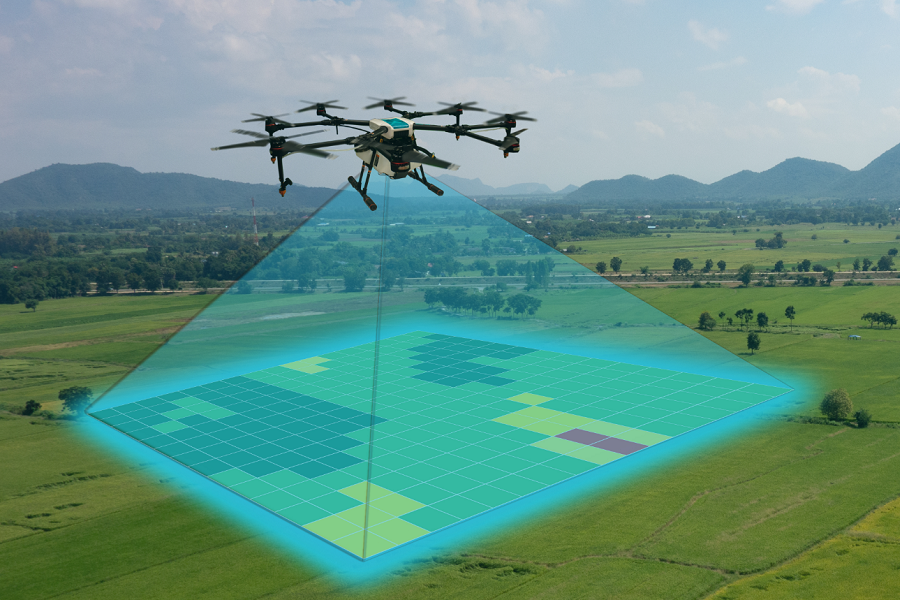
In the case study we present today, a DJI Mavic Multispectral drone was used for aerial surveys so as to obtain RGB (true color) and multispectral images of the vineyard examined. Through photogrammetry software, it was possible to construct the orthomosaic of the field from which maps based on vegetation indices could be extracted. In particular, a map based on the NDVI index was created and the corresponding zoning map considering 3 homogeneous areas (high, medium and low vigor). The evolution of the data, from raw to map, is presented in Figure 1.
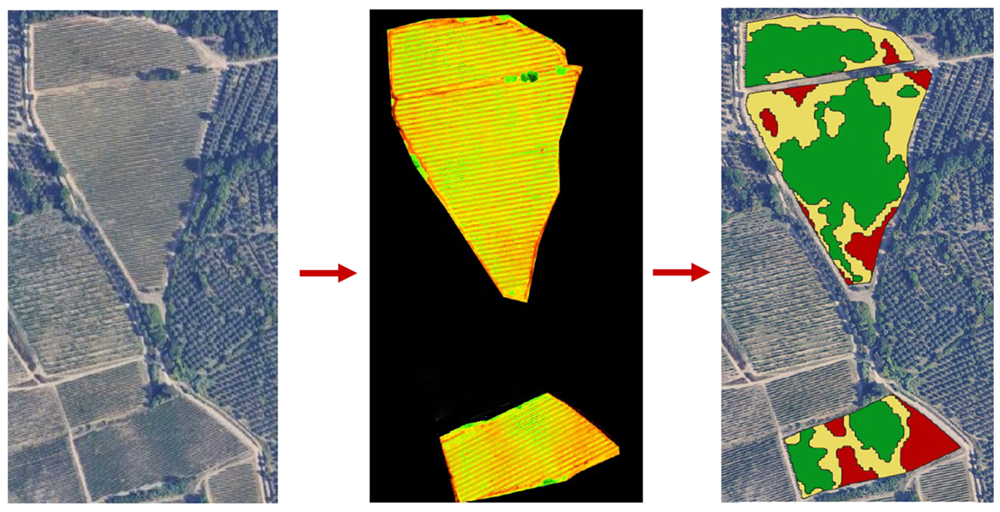
Fig.1: Image processing protocol: from RGB orthomosaic to NDVI map in order to generate homogeneous areas (green=high vigor; yellow=medium vigor; red=low vigor).
Zoning is essential for selecting areas in which to sample grapes. In detail, 9 sampling points were identified (Figure 2), that is, 3 points for each homogeneous zone shown in the figure. At each point, the following surveys were carried out:
1) 3D scanning of the vine plant using iAgro;
2) weighing and counting of grapes per plant;
3) analysis of the samples at an accredited laboratory.
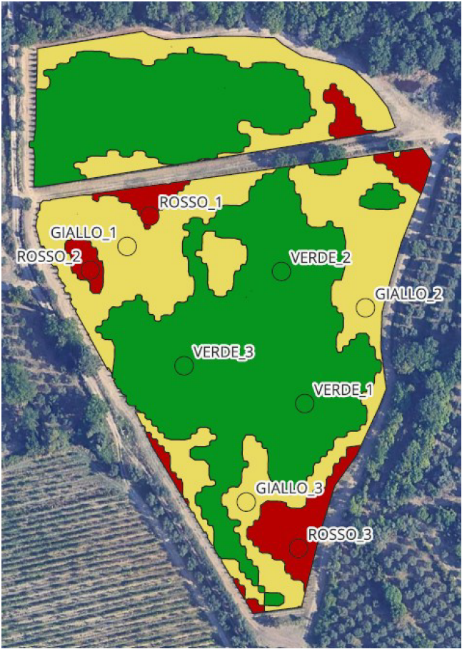
Fig.2: Grape sampling according to zoning.
The iAgro app creates the digital twin of the plant or portion of the row and measures key canopy biometrics: height, canopy thickness and volume, LAI (Leaf Area Index), TRV (Tree Row Volume) and LWA (Leaf Wall Area). Using these data, the optimal dose of plant protection mixture is also calculated.
For each selected plant, the clusters were counted, weighed and then analyzed to assess a number of parameters: average berry weight, marc-to-juice ratio, sugar concentration, total acidity, pH, malic acid, readily assimilable nitrogen (APA), anthocyanin extractability potential at pH 1, extractable anthocyanins at pH 3.2 and percentage of extractable anthocyanins, phenol index and percentage of tannins in the seeds.
Selective grape harvesting
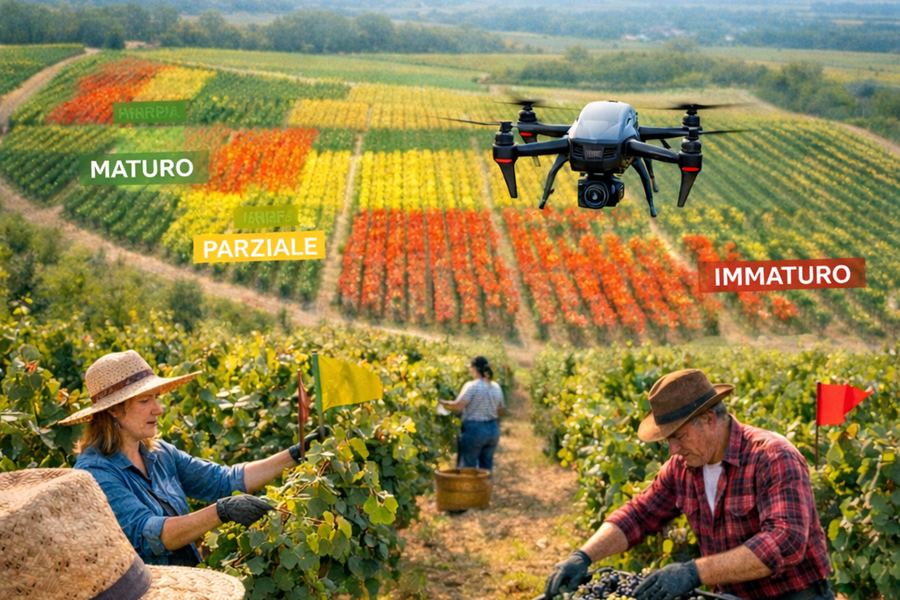
To obtain Chianti Classico “Gran Selezione” the best bunches were harvested from areas characterized by low vigor (in red). Better clusters are defined as sparse, medium to small sized clusters, in the absence of mold, rot, non-invasive berries and heat stroke burns. In a second pass, the remaining clusters were harvested, again in the red areas. In the third pass, clusters from the high vigor areas (in green) were harvested. Figure 3 shows the harvesting scheme used during tractor-mounted harvesting.
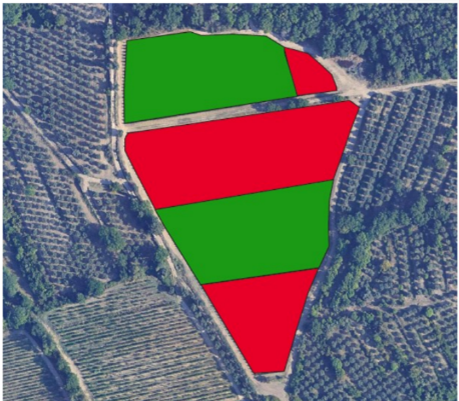
Fig.3: Harvesting scheme: medium-low vigor areas in red, high vigor areas in green.
It is important to specify that the 3 batches harvested were used for the production of 3 different wines. To avoid affecting the properties of the grapes, each winemaking process was carried out in the same way: same strain of selected yeasts, same additions of activators, nutrients and oenological additives.
Results: grapes and wines compared
Looking at the grape sampling data, it is evident how different vineyard vigor zones produce grapes with very different characteristics (Figure 4). High vigor areas show a higher production load, with larger bunches and grapes on average and a lower pomace-to-juice ratio. These conditions are directly reflected in grape composition, leading to lower sugar and total acidity values. As we move toward areas of medium to low vigor, production decreases but the concentration of key quality parameters increases. Another relevant aspect concerns malic acid, which is present in greater quantities in the more vigorous plants. This finding is mainly related to the microclimate of the cluster: in areas of high vigor, the more developed canopy protects the berries from direct radiation and high temperatures, slowing the degradation of malic acid compared to more exposed areas. Finally, in areas of low vigor there is a higher concentration of phenolic compounds.
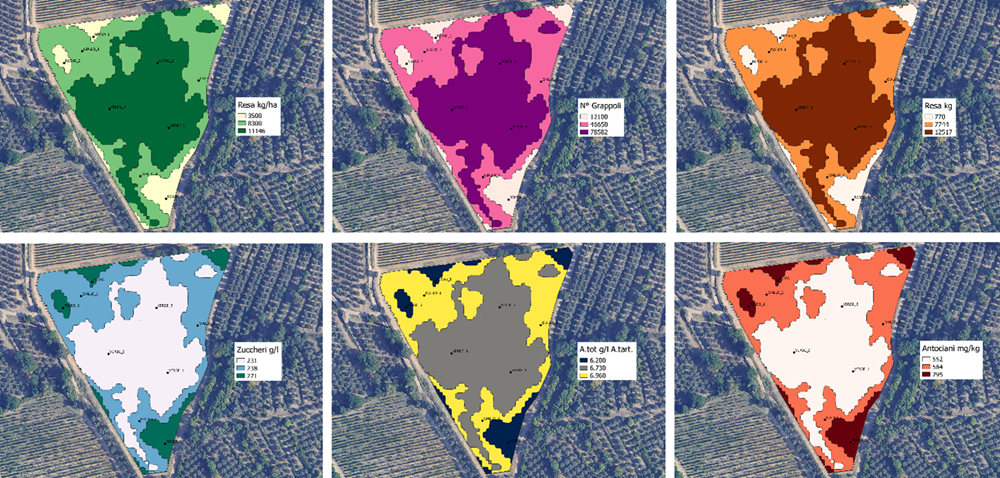
Fig.4: Maps of the main quantitative (yield per hectare, number of clusters, bunch yield) and qualitative (sugars, total acidity, anthocyanins) parameters.
Regarding the wines obtained from the 3 harvested lots (Table 1), the first obvious difference concerns grape production per hectare, which is clearly higher in the high vigor area, while it is similar in the other two lots. However, it significantly changes the wine yield, which follows a clear scale: 71% in the high vigor areas, 64% in the medium-low vigor areas (selected “Great Selection” clusters) and 56% in the medium-low vigor area. The difference between the latter is mainly related to the health status of the grapes, which, in the selection of the best bunches, did not show wilting or scalding phenomena.
Regarding acidity, an opposite trend is observed with respect to vigor: the lowest total acidity is recorded in wine obtained from grapes harvested in high vigor areas. The higher acidity in the low vigor areas is due to the concentration effect caused by water loss due to high summer temperatures. This affected both the increase in alcohol content and the acid component. In contrast, pH remains essentially stable. Volatile acidity is lower in Gran Selezione due to the better health status of the grapes, while malic acid is higher, confirming what was observed during sampling.
As for sugars, these are lower in high vigor areas and higher in low vigor areas (fewer grapes but more sugar concentration).

Tab. 1: Results of analysis on wines obtained from selective harvest.
Wines made from the residual clusters of the low-medium vigor areas, have an important structure and smoothness, well balanced and with good acidity but with a very high percentage of alcohol, significantly higher than in the current wine market. In contrast, wines made from grapes from high vigor areas have a more vertical profile, with a less preponderant structure that leaves room for the acid component, fruity aromas and a lower alcohol content. Finally, “Grand Selection” falls between the previous two wines, demonstrating that healthy grapes harvested in low-to-medium vigor areas give a balanced sensory profile, at the expense of quantity.
Conclusions
This case study shows how drone vigor maps can be used in a practical way to guide selective harvesting, making it more objective and easily applicable in the field. The results confirm that vineyard variability is directly reflected in grape and wine quality, allowing for sensoryally different batches from the same plot. In particular, healthy grapes from medium-low vigor areas gave the wine a more balanced profile, while other areas expressed different and complementary profiles.
Overall, the integration of data from drone and operational management of harvest is a concrete step toward more efficient, data-driven viticulture. Field variability is no longer an obstacle but an asset to be exploited.