

by Niccolo Bartoloni
Share

Prescription maps and VRA: what is variable rate application
Introduction
Prescription maps are the cornerstone of operational precision agriculture: they turn a multispectral image, sensor data or yield map into concrete instructions for the tractor. Several ISMEA and CREA analyses indicate that uniform dose of fertilizers and pesticides is still the standard in much of Italian agriculture, although internal variability within individual plots is frequently significant. Variable Rate Application ( VRA ) reverses this logic: it doses only where needed and as much as needed. This operations guide explains what a prescription map is, how it is generated, how it is transferred to an ISOBUS tractor, and how much it really saves in vineyards, olive groves, orchards, and arable crops.
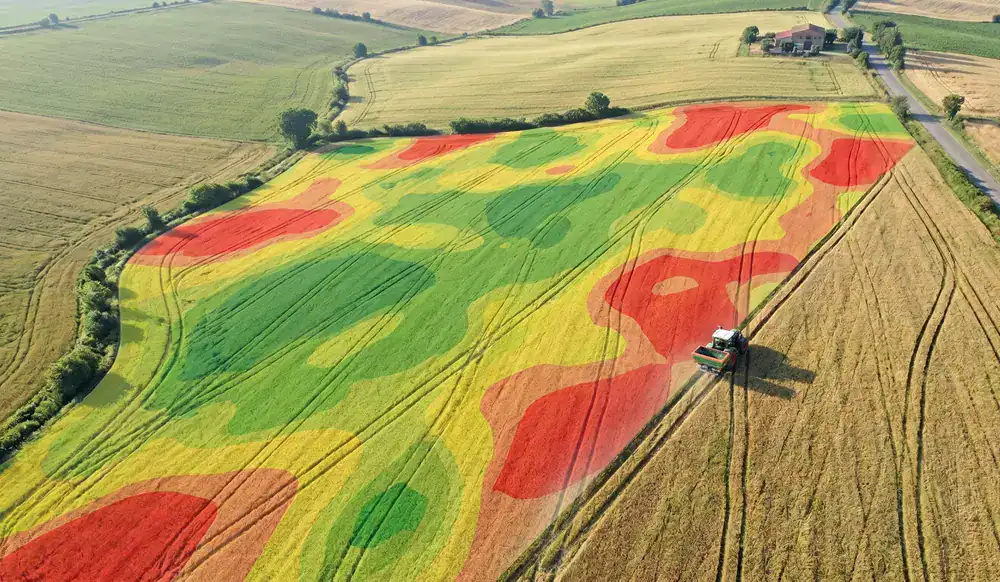
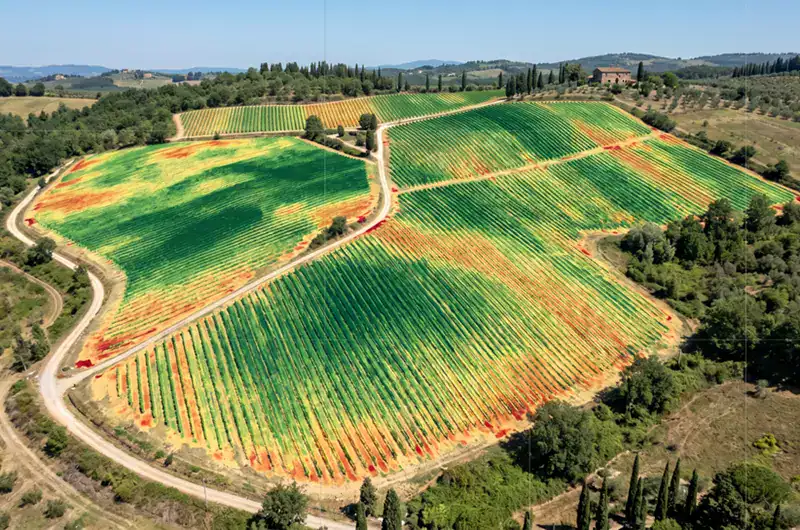
Fig.1: VRA prescription map on vineyard: color zoning indicates to the tractor the variable dose to be distributed in each sub-area.
What is a prescription map and what does it solve
A prescription map is a georeferenced file that divides a plot of land into homogeneous zones and assigns each zone a specific dose of an agronomic input (fertilizer, water, pesticide, seed). It is the “recipe book” that the agronomist hands to the operating machine for it to distribute different amounts at different points in the field, replacing the logic of the fixed dose with that of the calibrated dose.
The map solves a very real problem: internal variability within Italian plots is almost always high. Differences in soil texture, useful depth, exposure, microclimate, planting age and vegetative vigor mean that the same amount of nitrogen or plant protection product produces very different effects a few meters apart. Spreading evenly therefore means under-dosing in poorer areas and over-dosing in richer ones, with waste on both fronts.
15-30%: Typical reduction range in pesticide and fertilizer consumption reported in technical literature and European case studies of precision agriculture applied to vineyards, orchards and arable crops managed with prescription maps (source: elaboration on CREA technical review and Eurostat data on chemical input use, 2024).
Standard formats of a prescription map
Prescription maps are distributed in two families of formats: GIS vector (shapefiles .shp, GeoJSON, KML) and machine-tractor interchange standards (ISO-XML, part of the ISOBUS / ISO 11783 standard, and proprietary formats from manufacturers such as John Deere, CNH, Claas). Good practice is to generate the map in shapefile for storage and archiving and convert it to ISO-XML for transfer to the machine.
VRA: Variable Rate Application explained simply
Variable Rate Application (VRA) is the technique by which an operating machine modulates the distributed dose in real time following the directions of a prescription map or an on-the-go sensor. It is the “strong arm” of precision agriculture: without VRA, a map remains a mapping exercise; without a map, a VRA is blind.
Operationally, the VRA system works as follows. The tractor receives the geo-referenced prescription map; a GPS receiver (ideally RTK with centimeter accuracy) reads its location instant by instant; an ISOBUS controller controls the valve of the fertilizer spreader, sprayer, or seed drill by varying the dose or rate of application according to the area traversed. The operator only has to drive: the machine adjusts itself.
VRA for fertilization, irrigation, pesticides
Variable-rate applications fall into five main families, each with different technological maturity and diffusion in Italy:
- VRA fertilization: the most mature. Centrifugal and pneumatic spreaders accept ISO-XML maps and dose nitrogen, phosphorus or potassium according to zoning (vigor, historical yield, soil analysis).
- VRA phytosanitary treatments: sprayers and booms with variable rate or individual section nozzles, controlled by control unit and map, dose fungicides and insecticides according to leaf mass or risk.
- Variable rate seeding: precision seeders modulate seeding density according to soil capacity, especially useful in corn and cereals.
- Precision irrigation: sector sprinklers and drip wings with zoned valves deliver differentiated volumes according to CWSI maps and soil moisture.
- Selective harvesting: harvesters and pickers with systems to separate product into different hoppers, activated by the vigor or quality map.
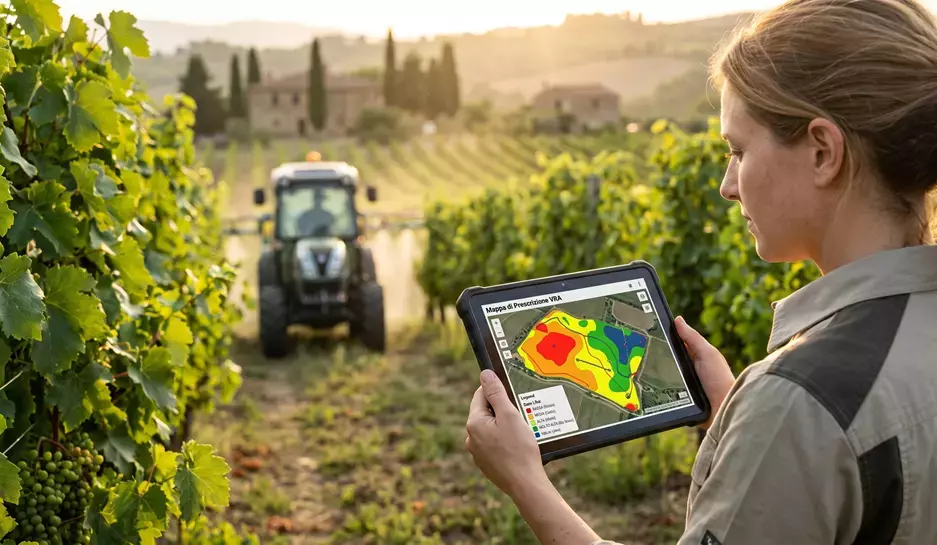
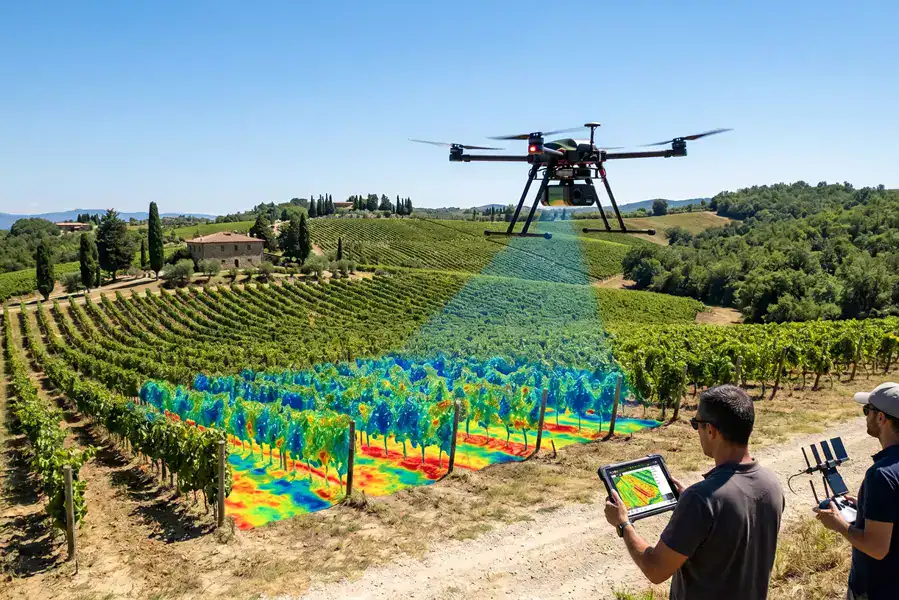
Fig.2: Variable rate application in vineyard: the tractor follows the prescription map and modulates the dose zone by zone.
VRA for selective collection
ERA is not only about inputs: it also applies to the output of the season. In viticulture, selective harvesting is now the main lever for enhancing quality wine. A pre-harvest NDRE map divides the vineyard into zones of different vegetative-productive balance; the harvester or picking teams direct grapes into separate lots. The same logic applies to olive and premium pome fruit trees. For a documented practical case study, Agrobit’s in-depth discussion of theuse of drone maps for selective grape harvesting is useful.
From data to map: the operational workflow
The flow from raw data to an operational prescription map has four stages, each with technical choices that affect the final quality.
Step 1: Data acquisition
There are multiple data sources that can be used. Multispectral orthomosaics with 2-10 cm/px resolution, NDVI/NDRE indices, and heat maps for CWSI are obtained from drone. The Sentinel-2 satellite provides free 10-m resolution images every 5 days, useful for grain and large areas. Field sensors (weather stations, soil moisture probes, leaf wetness sensors) return continuous point data. Historical yield maps from georeferenced combines are often the most solid basis for multi-year production zoning.
Step 2: zoning and prescription
The clustering algorithm (typically k-means or fuzzy segmentation) divides the field into 3-5 homogeneous zones for the parameter of interest. The choice of the number of zones is a trade-off between agronomic detail and the ability of the operating machine to handle rapid transitions: 3 zones work well for standard fertilizer spreaders, 5-7 zones require advanced ISOBUS equipment and individual section booms.The agronomist assigns a specific dose to each zone based on a protocol (soil analysis, crop removals, predictive models, regulatory constraints). For nitrogen fertilization, for example, low vigor zones may receive higher doses to recover productivity or, conversely, lower doses if the limiting factor is structural; the choice depends on the farm objective (maximum yield vs. quality balance).
Step 3: Transfer to the machine
The map is exported to ISO-XML or a proprietary format compatible with the tractor monitor, transferred via USB, SD card or cloud (Agrirouter, MyJohnDeere, Climate FieldView and the like) and uploaded to the job controller. In the field, the operator starts the tillage: the system automatically manages the doses by following the GPS location.
2-3 cm: Typical positioning accuracy of an RTK GPS receiver in precision agriculture, compared to 30-50 cm for a standard differential GPS and 2-5 m for a consumer GPS. Gain is critical for VRA over narrow rows and for self-steering (source: GNSS technical documentation for agriculture, Eurostat-JRC Agri Data Hub, 2024).
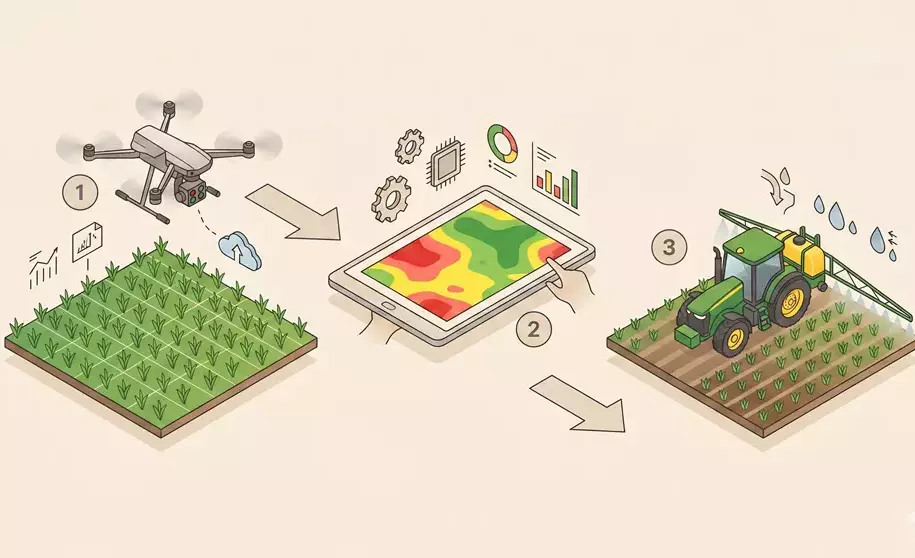
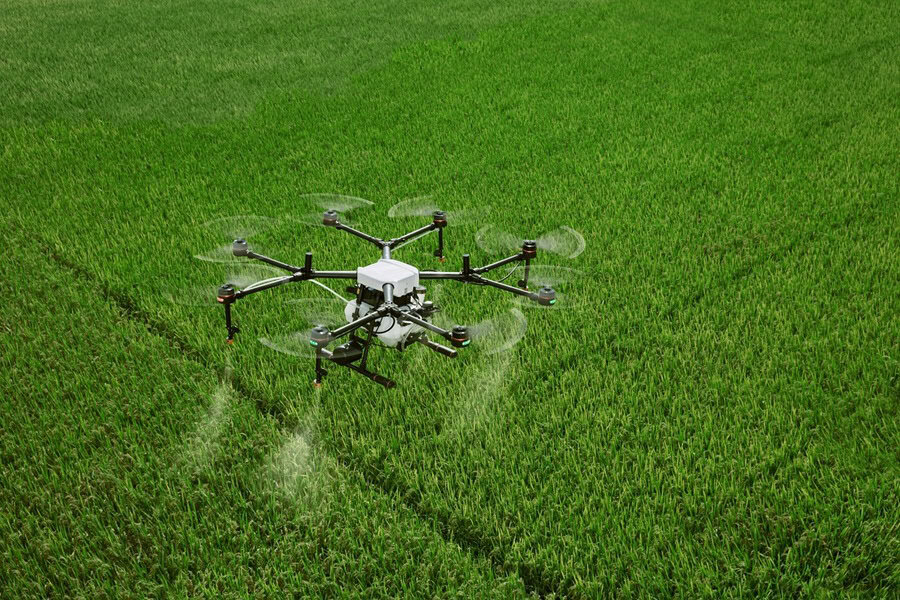
Fig.3: The VRA workflow in three steps: drone acquisition, prescription map generation, variable rate application in the field.
Tractor compatibility and ISOBUS standards
The ISOBUS standard (formally ISO 11783) is the communication protocol between tractor, equipment and monitor that makes ERA possible in interoperable mode, regardless of brand. A certified ISOBUS tractor communicates with any certified ISOBUS equipment via a standardized 7-pin cable, just like a smartphone with a USB-C charger.
What is needed on the tractor
To do “real” VRA you need four components: a GPS receiver (ideally RTK with base or regional CORS network for centimeter accuracy), an ISOBUS monitor with VRC (Variable Rate Control) or Task Controller license, compatible equipment (fertilizer spreader, sprayer, seeder, tiller), a compliant ISOBUS cable. The initial investment is significant but scalable: many Italian contractors already offer the turnkey service to companies that do not want to equip themselves with their own hardware.
When the tractor is not ISOBUS
For equipment fleets not yet ISOBUS, intermediate solutions are available: retrofit kits with universal monitors (Trimble, Topcon, John Deere, Hexagon) that interface with pneumatic or hydraulic valves on existing equipment. Performance is less than a native system, but sufficient for fertilization and 3-5 zone treatments. For continuous monitoring during tillage, systems such as iTractor with stereoscopic cameras add a layer of computer vision that integrates even on older tractors.
How much you save with VRA: numbers and ROI
The economic benefits of ERA depend on three variables: actual field variability, unit cost of input, and plot size. Under average Italian conditions, the savings documented in the technical literature and European case studies are in the following ranges.
- VRA nitrogen fertilization: 10-20% savings on nitrogen distributed for the same yield, with reduced leaching losses and compliance benefits with the Nitrates Directive and CAP eco-schemes.
- VRA phytosanitary treatments: savings of 15-30% on the amount of product distributed, especially in vineyards and orchards where leaf mass variability is high.
- Precision irrigation: water savings in the range of 20-40% in the most virtuous situations, particularly significant in regions of increasing water stress such as Puglia, Sicily, Sardinia and Emilia-Romagna.
- Variable rate seeding: yield increases of 3-8% in maize and cereals on plots with highly variable soil texture, for the same seed cost.
In addition to direct input savings, ERA yields indirect benefits that are often more relevant: reduction of the farm’s carbon footprint (relevant to CSRD and sustainability budgets), access to CAP 2023-2027 eco-schemes that reward precision agriculture, improved product quality, and greater uniformity in PDO/PGI supply chains.
-20%: Reduction target in fertilizer use by 2030 set by the European Farm to Fork strategy of the Green Deal; ERA and prescription maps are among the key tools indicated at the institutional level to achieve this target at the farm level (source: European Commission, Farm to Fork strategy communication, captured in Agri 4.0 NRP plans, 2023).
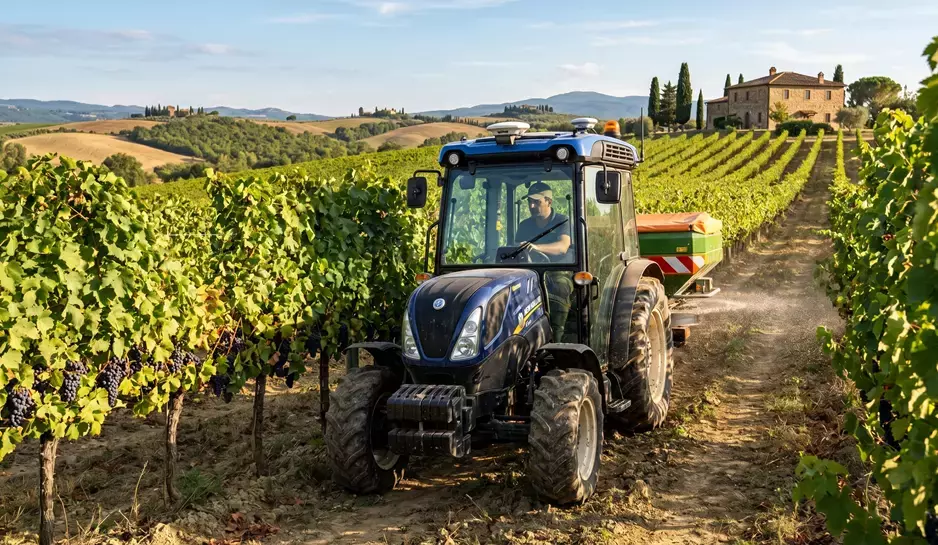
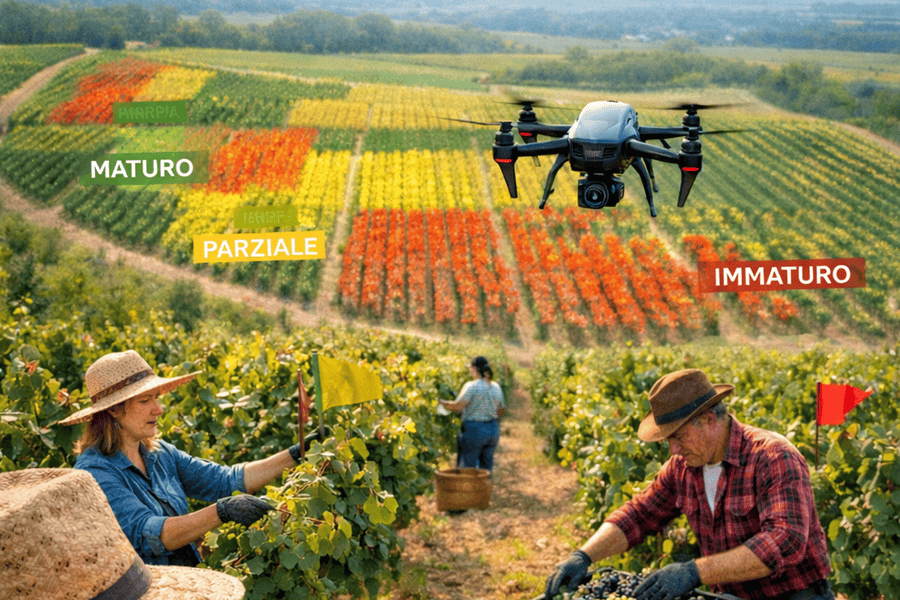
Fig.4: VRA application in the vineyard.
When the VRA doesn’t pay off
VRA is not always the right choice. On very small plots (under 2-3 hectares), very homogeneous or with low input intensity (e.g., traditional extensive olive grove), the costs of data acquisition, map generation and ISOBUS hardware may outweigh the benefits. The rule of thumb is to assess internal variability: if two points 50 meters apart in the same field require the same intervention, the map is useless; if they require different interventions, the ERA pays off.
Common mistakes when applying prescription maps
Field experience highlights five recurring mistakes that reduce or negate the value of the VRA. Knowing them helps avoid frustration and ineffective investments.
- Too fine zoning: breaking the field into 8-10 zones on equipment that handles only 3 transitions per second creates delivery instability and average doses little different from uniform.
- Data too old: an NDVI map from a month ago may no longer represent the current situation, especially during rapid development phases or after weather events. Maps need to be updated.
- Lack of ground validation: interpretation of remote data should always be compared with an agronomic inspection. A “red” zone can be water stress, fungal attack, root problem, poor soil: the prescription changes dramatically.
- Mishandled data transfer: files in incompatible formats, projection errors, wrong coordinate systems. These seem like details, but they stop the construction site.
- Untrained operator: the ISOBUS monitor requires specific skills. Without training, even the best VRA system is disabled by the operator after the first problems.
To avoid these mistakes, many Italian companies choose to rely on specialized contractors or integrated services that manage the entire data-map-application chain. Agrobit, for example, supports cooperatives, contractors and structured companies in end-to-end operational flow design.
Frequently asked questions about prescription maps and VRAs
What is a prescription map in agriculture?
A prescription map is a georeferenced file that divides an agricultural plot into homogeneous zones and assigns each zone a specific dose of an input (fertilizer, water, pesticide, seed). It is the “recipe book” that the tractor or sprayer follows to distribute different amounts at different points in the field, replacing the uniform dose.
What format does a VRA map have (shapefile, ISO-XML)?
The most popular formats are shapefile (.shp + .dbf + .shx + .prj) for GIS storage and management and ISO-XML (ISO standard 11783) for transfer to the ISOBUS tractor. There are also proprietary formats from some manufacturers (John Deere, CNH, Claas, Trimble). A good practice is to generate in shapefile and convert to ISO-XML at the time of use.
Do you need a particular tractor for the VRA?
You need a tractor with a certified ISOBUS interface, a monitor licensed Task Controller VRC, and a GPS receiver preferably RTK for centimeter accuracy. For non-ISOBUS tractors, there are retrofit kits with universal monitors (Trimble, Topcon, Hexagon) that allow VRA on 3-5 zones with acceptable performance.
How much can you save with variable rate fertilization?
Data reported in the European technical literature indicate savings of 10-20% on nitrogen distributed for the same yield, with additional compliance benefits to the Nitrates Directive and CAP 2023-2027 eco-schemes. The figure varies with field variability and cropping intensity: very homogeneous plots show smaller savings.
Can the ERA also be done for plant protection treatments?
Yes, and it is one of the fastest growing areas. Sprayers with variable-rate nozzles, individual section booms or foggers with electronic flow meters dose fungicides and insecticides based on leaf mass measured with sensors or a preventive prescription map. Documented savings are as high as 15-30% on the amount of product distributed.
Can prescription maps be done with a smartphone?
In part, yes. DSS apps like iAgro generate vigor maps from RGB photos and Sentinel-2 data, which can become the basis for a simple prescription map (3 zones) exportable to shapefile. For professional VRA on ISOBUS sprayers and spreaders, however, the prescription map is generated in a GIS environment and transferred to the machine via ISO-XML.
Do you want to activate ERA on your farm?
Agrobit accompanies farms, cooperatives and contractors from drone survey to prescription map to transfer to the operating machine. With iTractor we monitor during processing; with iDrone we generate high-precision multispectral maps. Talk to one of our technicians to build the right operational flow for your supply chain.
▶ Contact an Agrobit technician. ▶ Explore the Agrobit blog
Also learn more about solutions for agricultural cooperatives and the applications of drone treatments in agriculture.