

by Simone Kartsiotis
Share
Water stress and CWSI index: a guide to precision irrigation
Introduction
Crop water stress has become one of the main risks for Italian agriculture: river droughts, heat waves and poor winters in recent years have shifted irrigation from a supplementary practice to a strategic lever for yield and quality. According to FAO and ISPRA data, water stress affects growing portions of Italy and Europe. Measuring water stress objectively, before it becomes visible damage, is now possible thanks to the CWSI index calculated from thermal images acquired by drone. This guide explains how it works, how to interpret it, when to fly it, and how to integrate it with soil sensors and weather stations to build truly effective precision irrigation.
Water stress in crops: causes, physiology, and impacts
Crop water stress is the physiological condition in which the plant cannot meet the transpirational demand imposed by the atmosphere with the water available in the soil. When the vapor pressure deficit(VPD) increases and water in the soil becomes scarce, stomata close, photosynthesis slows down, and leaf temperature increases.This remotely readable thermal increase is the physical basis of CWSI.
The causes of water stress are many: lower winter rainfall, increasingly frequent summer heat waves, soils with low field capacity, and unzoned irrigation systems. Impacts range from yield reduction to loss of caliber in fruit, from altered sugar/acidity ratios in grapes to flower abortion in olive groves, to the risk of permanent stress on young tree crops.
20-50%: Estimated potential water savings for farms adopting zoned precision irrigation systems compared to traditional uniform irrigation regimes, based on documented experiences in Italian viticulture and fruit and vegetable supply chains (source: elaboration on FAO Aquastat data and ISPRA reports on water status).
Water stress in viticulture: positive or negative?
Grapes are one of the few crops for which some degree of water stress is desired. A moderate controlled water deficit between veraison and harvest promotes the concentration of sugars, polyphenols and anthocyanins, contains vegetative vigor and improves potential wine quality, particularly in structured red wines and PDOs with strong territorial identity.
However, the balance point is subtle: beyond a certain threshold, water stress becomes damage. Prolonged stomatal closure blocks photosynthesis, reduces ripening and is likely to leave after-effects on the following season. Measuring stress objectively, with CWSI or leaf potential, allows the winemaker to stay within the “quality” window without exceeding the critical threshold.
Water stress in olive growing, fruit growing and horticulture
In olive cultivation, on the other hand, water stress should be minimized at sensitive stages such as pinking, fruit set, and fruit enlargement: a deficit in these phenologies produces fruit drop, oil yield decline, and size reduction. In fruit (stone fruit, pome fruit, citrus) and horticulture, the link between water availability and caliber/quality is even more direct, and CWSI maps guide zonal irrigation scheduling.
How to measure water stress: direct and indirect methods
Measuring water stress means quantifying the balance between water lost through transpiration and water available to the plant. There are direct methods, based on laboratory or field measurements on the plant and soil, and indirect methods, based on thermal and multispectral remote sensing. The two approaches are complementary: the former provide the truth reference, the latter the spatial coverage and frequency.
Direct methods: leaf potential, tensiometers, TDR probes
Foliar water potential measured by Scholander chamber is considered the scientific gold standard for quantifying plant water status: it is expressed in MPa (negative) and has known thresholds by crop and phenological stage. It is accurate but requires experienced operators, is timely and does not scale well over large areas.
Tensiometers and TDR (Time Domain Reflectometry) or capacitive probes, on the other hand, measure soil water availability at different depths. They allow continuous remote monitoring but represent a point in the field and not the actual physiological response of the plant. To overcome the limitation of spatial representativeness, each farm should be covered by at least one probe each homogeneous zone (by soil type, exposure, variety).
Indirect methods: thermal and multispectral remote sensing
Remote sensing covers the spatial gap. Agricultural drone thermography measures canopy temperature with long-wave IR sensors (8-14 µm) and, combined with weather data, feeds into CWSI calculations. In parallel, multispectral indices such as NDRE, OSAVI or the NIR/SWIR reflectance ratio provide complementary information on the vegetative state and possible water content of the canopy.
To delve deeper into acquisition platforms, it is useful to look at the overview of the drone sensors dedicated to agriculture, where pros and cons of multispectral and thermal sensors in different seasons and phenologies are described.
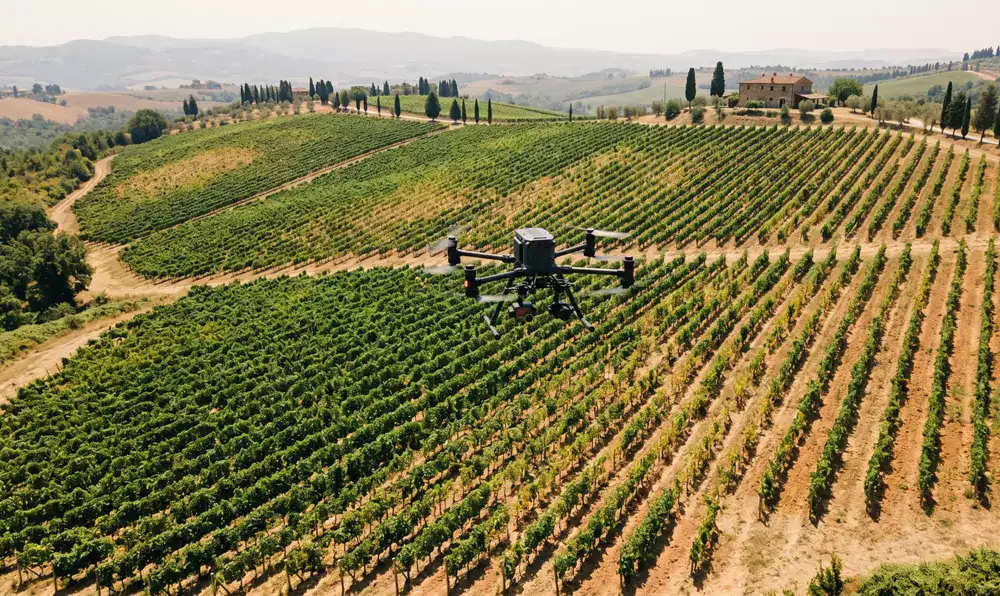
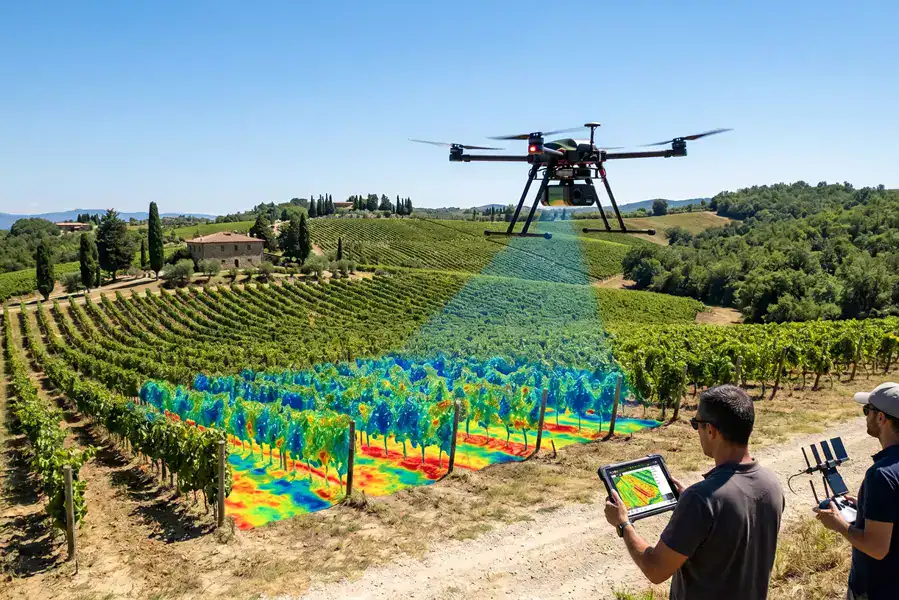
Fig.1: Thermal acquisition with drone in vineyard: the optimal flight window is 11:00 a.m. to 2:00 p.m. in sunny and stable days, a necessary condition for reliable CWSI.
The CWSI index: definition, formula and operational thresholds
The Crop Water Stress Index (CWSI ) is a dimensionless index between 0 and 1 that measures the level of water stress in a crop by comparing the canopy temperature with two theoretical references under the same weather conditions: the temperature the same crop would have in the absence of stress (well watered) and the temperature it would have under maximum stress (stomata completely closed).
The physiological basis of the CWSI is simple: a well-hydrated plant transpires and, by evaporative cooling, keeps the canopy cooler than the air; in a water shortage the stomata close, transpiration drops, and the canopy heats up. The Crop Water Stress Index normalizes this thermal difference between two theoretical limits. In the established formulation in the literature (empirical formulation of Idso and theoretical formulation of Jackson, 1981) the index is written in normalized form as:
CWSI = (dT – dTLL) / (dTUL – dTLL)
where dT = Tc – Ta is the measured difference between the canopy temperature(Tc, from thermal imaging) and the air temperature(Ta), in °C. The two terms of reference are:
- dTLL(lowerlimit, lower baseline): Tc – Ta difference expected in awell-watered, fully transpired crop(non-water-stressed baseline). It is usually negative, because the canopy is cooler than air, and depends on the vapor pressure deficit (VPD).
- dTUL(upperlimit, upper baseline): expected difference in a fully stressed, nontranspiring crop with closed stomata and canopy warmer than air; positive value.
When dT coincides with the lower baseline the index is worth 0 (water well-being); when it coincides with the upper baseline it is worth 1 (maximum stress). The lower baseline is typically modeled as a VPD straight line in the form dTLL = a – b – VPD, with the coefficients a and b to be calibrated by species, variety and local climate. VPD(Vapour Pressure Deficit) is obtained from the weather station by measuring air temperature and humidity simultaneously.
Typical operational thresholds of interpretation are:
- CWSI 0 – 0.2: water welfare, well-watered crop, no intervention.
- CWSI 0.2 – 0.4: mild stress; in quality viticulture often falls within the controlled irrigation deficit (RDI) threshold sought between post-harvest and pre-harvest to contain vigor and improve grape quality.
- CWSI 0.4 – 0.6: moderate stress; irrigation intervention to be evaluated for most crops (orchards, table olive).
- CWSI 0.6 – 0.8: severe stress, risk of yield and quality decline: intervene.
- CWSI > 0.8: critical stress, physiological damage in progress.
Thresholds are indicative: they should be calibrated in the field by crop, phenology and production objective. Controlled irrigation deficit deliberately administers volumes below potential requirements at selected phenological stages, taking advantage of vine tolerance to improve the skin-to-pulp ratio and polyphenolic profile of grapes.
The FAO-56 water balance: from CWSI to crop requirements.
The CWSI tells whether the crop is under stress at a given instant; estimating how much water to return requires a water balance. The international reference method is the crop coefficient method described in FAO Irrigation and Drainage Paper 56, which calculates crop evapotranspiration as:
ETc = Kc × ET0
where ETc is the crop evapotranspiration (mm/day), i.e., the water actually lost by the soil-plant system; ET0 is thereference evapotranspiration (mm/day), calculated with the FAO-56 Penman-Monteith equation on a standard reference meadow from net radiation, temperature, humidity and wind speed; Kc is the crop coefficient (dimensionless), which corrects ET0 according to species, phenological stage and canopy architecture. The farm weather station provides inputs for ET0, while Kc scans the irrigation season by phenological stages.
Indicative Kc values for Mediterranean trees (FAO-56 and local adaptations, again to be calibrated by areal and farming system) are:
- Wine grapevine (espalier system): budding Kc ≈ 0.30-0.45; full vegetation/bloom Kc ≈ 0.70-0.80; veraison-ripening Kc ≈ 0.45-0.60.
- Olive tree: vegetative resumption Kc ≈ 0.55-0.65; flowering-ripening up to ≈ 0.65-0.70; drupe growth/ripening Kc ≈ 0.50-0.65, reduced in dry regime.
The intersection of theoretical budget (ETc) and physiological data (CWSI) is the heart of the method: if the CWSI signals ongoing stress while the budget is balanced, it is a sign that the adopted Kc needs to be updated or that the system distributes water unevenly.
When to fly with thermal drone
The quality of CWSI depends critically on the conditions of thermal data acquisition. The optimal window is the 11:00 a.m. to 2:00 p.m. time slot on sunny, stable and windy days, ideally with clear skies for at least 30 to 60 minutes before flight. Under these conditions, the difference between well-watered and stressed canopy reaches maximum thermal contrast and CWSI calculation is reliable.
Flights on cloudy days or with variable cover (canopy cools unevenly), in high winds (turbulence on canopy temperatures) or during sunrise/sunset time slots (thermal deltas too low) should be avoided instead. The recent presence of rain or irrigation also alters the data for a few hours.
The operational protocol is to measure air temperature and VPD concurrently with the flight with the local weather station: without these parameters, the dTLL and dTUL baselines cannot be set correctly, and the CWSI remains qualitatively readable but quantitatively unreliable. The standardization of acquisition conditions (sunny noon, clear sky, constant irradiance, low wind) is what makes water stress maps from the same farm comparable over time.
11:00 a.m. to 2:00 p.m.: Recommended time window for thermal flights aimed at CWSI calculation under Mediterranean conditions: maximum thermal contrast between well-watered and stressed canopy, clear sky and high VPD.
From heat map to irrigation plan
A CWSI map has value only if it becomes an irrigation plan. The standard operational flow involves five steps: flight planning, thermal and RGB reference acquisition, mosaic processing and CWSI calculation, zoning into homogeneous classes, translation into irrigation plan or prescription map for zoned microirrigation systems. It is a process that integrates agronomy, computer vision and irrigation mechanics.
Zoning and intervention classes
Zoning divides the CWSI map into 2-5 homogeneous zones by stress level. Each zone receives a consistent operational recommendation: no intervention where CWSI is low, standard irrigation average, reinforced or early irrigation where CWSI is high. In many plots, the map also reveals differences in pedology or soil depth that guide future irrigation system redesign.
Compatibility with zoned microirrigation systems
Precision irrigation translates into action through spatially compatible systems. Drip drip with sectors, modulating rain wings, variable flow hoses are the most mature technologies to apply a zonal irrigation plan. Automation systems connected to controllers and DSS close the loop, alternating volumes and shifts according to the latest CWSI map.
Use cases: vineyard, olive grove, orchard, vegetable garden
The operational applications of CWSI are broad. In DOC/DOCG vineyards it guides controlled deficit management. In high-intensification olive groves it identifies areas where younger plants or those on light soils suffer first. In stone fruit and pome fruit orchards, it helps safeguard caliber in the swelling stage. In horticultural and industrial crops (corn, processing tomatoes) it supports seasonal irrigation choices.
The service’s thermal and multispectral surveys. iDrone include CWSI calculation as part of integrated agronomic analysis packages for high value-added supply chains. Real-world examples are recounted in Agrobit case studies devoted to maps and models to support grape growers and to maps and models to support olive growers.
Integration with soil sensors and weather stations
CWSI from drone photographs stress in an instant; scheduling irrigation over time requires continuity of field data. The winning combination is the triad drone + soil probes + weather controller, powered by a DSS that reconciles the three sources and suggests volumes and shifts.
Soil moisture probes
Multilevel capacitive probes or TDR probes measure moisture at different depths (typically 20, 40, 60 cm) and show in real time where irrigation water “goes down”. They are the perfect complement to CWSI: the drone map tells where there is stress, the probes tell if the soil is really in deficit or if the root system is failing to absorb despite the presence of available water.
Physical and virtual weather stations
The weather station provides the parameters (temperature, humidity, radiation, rainfall, wind) needed to estimate reference evapotranspiration (ETo) and VPD. High-resolution virtual weather stations integrate numerical models and satellite data when a physical station is not available at the farm level.Potential evapotranspiration is the backbone of any crop water balance model.
DSS and water balance models
An irrigation DSS aggregates the three data sources and calculates residual crop requirements. The typical model is based on the FAO-56 equation (ETc = ETo × Kc), corrected with actual probe data and the CWSI constraint: if the CWSI says “stress in place” even when the theoretical budget is balanced, it is a sign that the model needs to be updated with a new Kc or that the irrigation system has an uneven distribution. The app iAgro integrates super-local weather forecasts, satellite indices (NDMI, another spectral index used to monitor water stress) and crop models to support these farm-level decisions.
Operational case: controlled water deficit in vineyard
A 25 ha Tuscan Sangiovese PDO vineyard has been integrating a CWSI-based protocol for several seasons. The operational logic is as follows: two seasonal thermal surveys (one post-allegation, one post-grafting) generate two stress maps on which to calibrate irrigation management. The goal is not to “zero stress” but to keep it within a target quality window (CWSI 0.2-0.4) between veraison and harvest, while still safeguarding the most sensitive areas (sandy soils, warmer exposures).
Maps reveal important differences between plot areas: areas on deep soils with low CWSI remain under “no irrigation,” areas on light soils with less developed root systems receive targeted interventions. Several analyses of the Italian agricultural sector indicate that the combination of thermal remote sensing, field probes and DSS can reduce overall vineyard water consumption for the same potential quality; in premium viticulture the goal is not only to save water but to distribute it better.
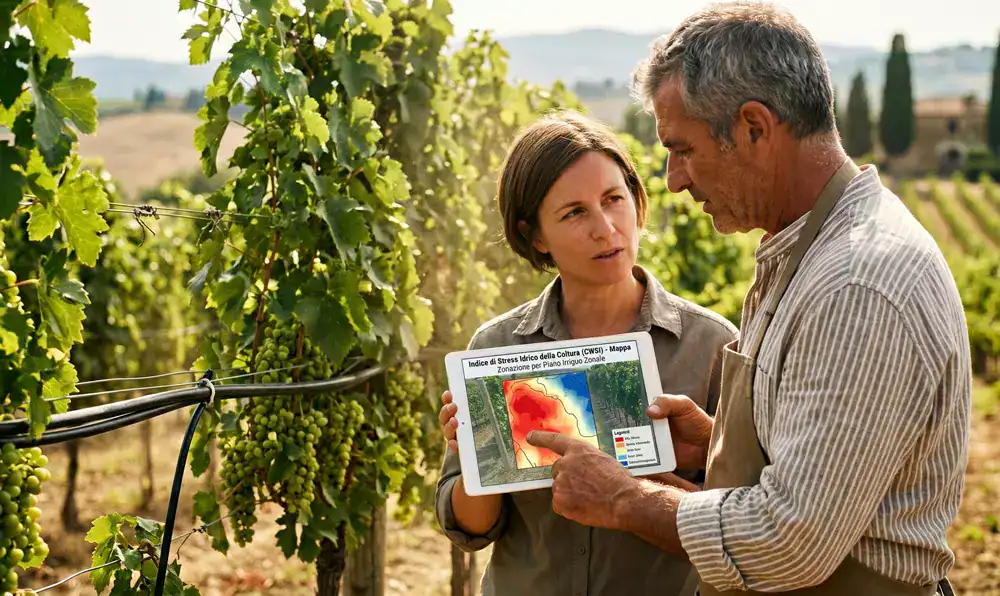
Fig.2: From CWSI map to irrigation plan: viticulturist and agronomist decide in the field where to reinforce drip shifts according to stressed areas, safeguarding quality deficit in others.
Compliance with eco-schemes and notices
The adoption of precision irrigation practices is consistent with the goals of the 2023-2027 CAP (eco-schemes on sustainable resource use), the European Green Deal and the Farm to Fork strategy on input reduction. The Agri 4.0 NRP and regional calls (RDP/CSR, ERDF) fund sensors, drones, DSS software, and training, making a CWSI protocol accessible even to small- to medium-sized farms. Learn more about the calls for proposals and funding for digital agriculture are available on the Agrobit blog.
Frequently asked questions about water stress and CWSI
What is the CWSI index?
The Crop Water Stress Index (CWSI) is a dimensionless index between 0 (no stress) and 1 (maximum stress) that measures the water stress of a crop by comparing canopy temperature with air temperature and with theoretical references of a well-watered, fully stressed crop under the same weather conditions.
How do you detect water stress in a vine?
It is detected by three complementary approaches: direct measurements (leaf potential with Scholander chamber, tensiometers or soil moisture probes), thermal remote sensing (CWSI maps from drone) and multispectral remote sensing (NDRE, OSAVI). Integration between spatial data (drone) and continuous data (probes) is the most robust operational model.
Can you see the water stress from satellite?
Yes, partially. The Sentinel-3 satellite and other thermal sensors provide surface temperature maps but with resolution of hundreds of meters, which are unsuitable for the row scale. The Sentinel-2 satellite in SWIR band and with indices such as NDWI provides indirect indications. For calculation of a CWSI at the row scale, the thermal drone remains the reference tool.
When is the best time for a thermal flight?
The optimal window is the time slot 11:00 a.m. to 2:00 p.m. solar time on sunny, stable days with clear skies for at least 30 to 60 minutes before the flight. Variable skies, high winds, extreme time slots (sunrise and sunset), and flights close to recent rains or irrigation should be avoided.
Is controlled water stress good for wine?
A moderate water deficit between veraison and harvest can improve the potential quality of structured red wines: it increases sugar, polyphenol and anthocyanin concentration, contains vegetative vigor, and improves sensory profile. However, the quality window is narrow: beyond the threshold it becomes damage. Measuring with CWSI allows you to stay in the right window.
How much can you save with precision irrigation?
Documented experiences in Italian supply chains indicate water savings in the range of 20-50% compared to traditional uniform irrigation regimes, depending on the crop, soil type, and starting irrigation system. The savings are accompanied by improved water distribution and better quality control of production.
Conclusions
Agrobit designs integrated CWSI protocols for vineyards, olive groves, orchards and arable crops: thermal drone surveys with iDrone, integration with field probes and weather stations, agronomic support for map reading and irrigation scheduling. Talk to one of our technicians to build the right flow for your supply chain.
▶ See iDrone service ▶ See field sensors and controllers
For companies seeking an end-to-end operational pathway, the tools for the farm business and insights on the sustainability of Agrobit technologies.