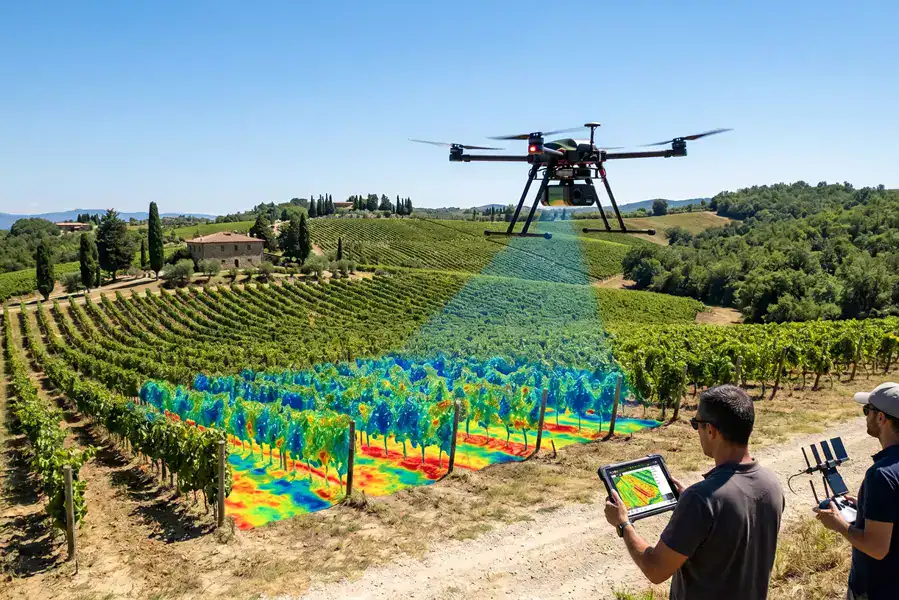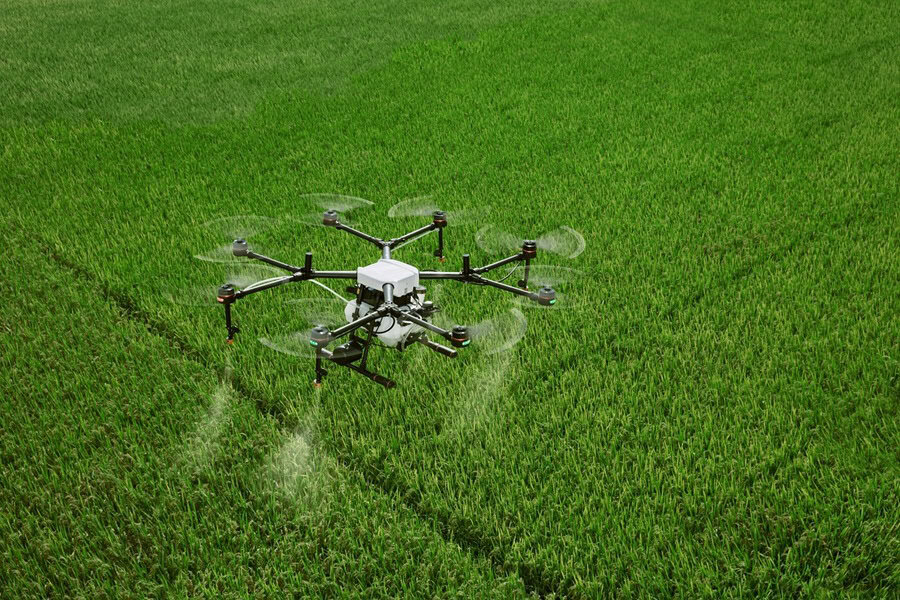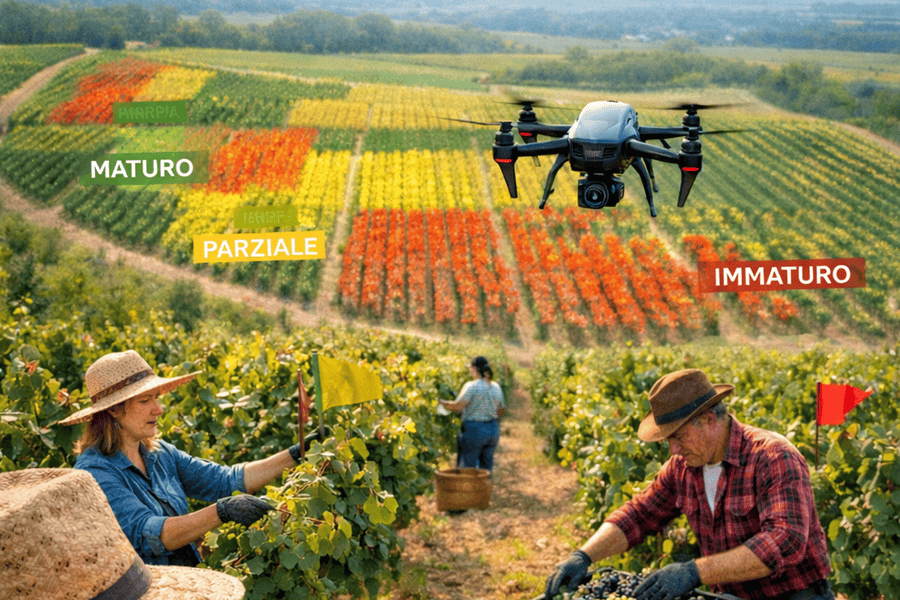


by Simone Kartsiotis
Share
NDVI, NDRE, GNDVI vegetation indices: comprehensive technical guide
Introduction
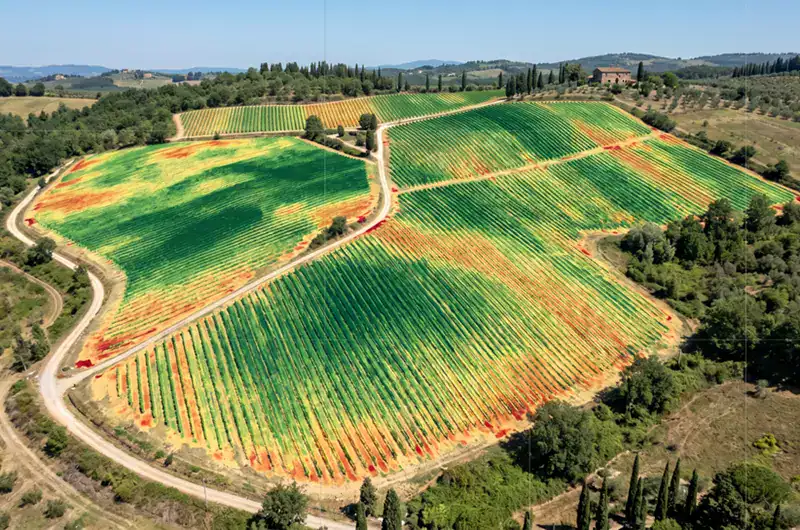
Vegetation indices are now the common language of Italian precision agriculture: from the Chianti vineyard to the Apulian olive grove, agronomists and companies are using NDVI, NDRE and GNDVI to read crop health without walking every row. Several ISMEA analyses indicate that the adoption of remote sensing tools on Italian farms is growing steadily, driven by the 2023-2027 CAP and eco-schemes that reward input reduction. This technical guide explains what vegetation indices are, how they are calculated, where each really pays off, and how to turn them into concrete agronomic decisions on vines, olive trees, orchards, and arable crops.
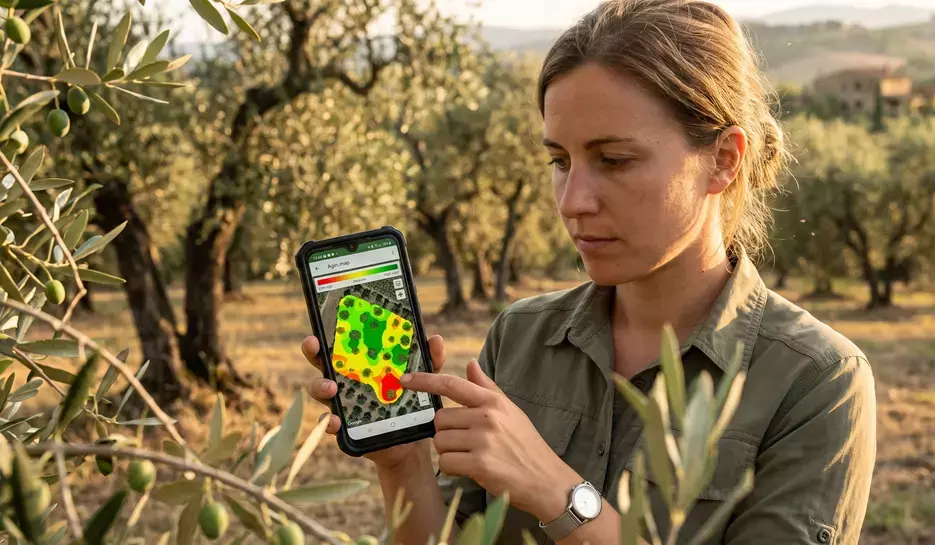
Fig.1: NDVI map: the color gradient highlights areas of different vegetation vigor, the starting point for each vegetation index.
What are vegetation indices and what they are used for
A vegetation index is a dimensionless number calculated as an algebraic combination of reflectance in two or more spectral bands; it is used to nondestructively estimate biophysical quantities such as vigor, chlorophyll content, biomass and water stress. It is the fastest way to transform a multispectral image into readable agronomic information at both row and district scales.
The use of vegetation indices rests on three distinct application families. The first is diagnosis: understanding where the crop is growing well and where it is not, identifying early disease outbreaks, mapping nutritional deficiencies. The second is prescription: turning the map into homogeneous zones for fertilization, irrigation, treatments, harvesting or selective harvesting. The third is monitoring over time: comparing the same crop in successive seasons or along the current season to assess the effect of agronomic practices and climatic conditions.
Spectral reflectance: the underlying physical principle
Plants selectively reflect, absorb and transmit light. Chlorophyll absorbs strongly in the red around 660 nm and in the blue, while the cell structure of the mesophyll reflects high amounts of radiation in thenear infrared (NIR, 700-1300 nm). Thus, a vigorous plant shows low reflectance in the red and high in the NIR; a stressed or senescent plant sees the ratio approach and the index values fall.
All “Normalized Difference” indices take advantage of this property: they relate a band where the plant absorbs to a band where it reflects a lot, normalizing on the sum to obtain a stable and comparable range across plots, seasons and sensors.
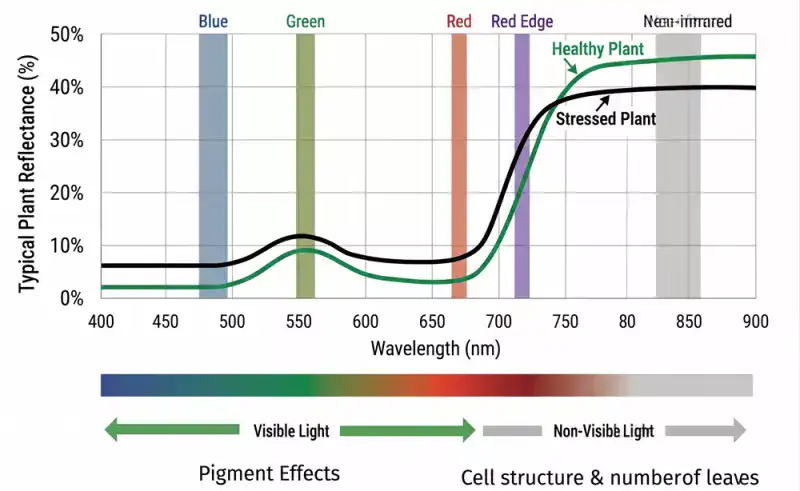
Fig.2: Spectral signature (or reflectance curve) of vegetation.
Red edge band and near infrared
The red edge is the transition region between absorption in the red and high reflectance in the NIR, typically between 690 and 740 nm. It is the area of the spectrum most sensitive to small changes in chlorophyll and foliar nitrogen and is what makes NDRE a more “nervous” index than NDVI in the late stages of the crop cycle, when leaf cover is already full.
Agricultural multispectral sensors, whether on drone or satellite such as Sentinel-2 from the Copernicus program, include at least one red edge band precisely to overcome the limitations of NDVI alone. To delve deeper into the technology, it is useful to start with the drone sensors and the choice of available bands.
NDVI: the normalized differential vegetation index.
NDVI (Normalized Difference Vegetation Index) is the normalized differential vegetation index. It returns a value between -1 and +1 and is the historical benchmark of agricultural remote sensing, with four decades of scientific literature behind it and availability on any multispectral sensor, from the free Sentinel-2 satellite to precision drone cameras.
The mathematical formula is: NDVI = (R_NIR – R_RED) / (R_NIR + R_RED), where R_NIR is the reflectance in near infrared and R_RED is the reflectance in visible red. Typical interpretation thresholds are as follows:
- NDVI < 0: water, snow, clouds.
- 0 – 0.2: bare soil, rock, artificial surfaces.
- 0.2 to 0.4: sparse or stressed vegetation.
- 0.4 – 0.6: moderate vegetation, developing crops.
- 0.6 to 0.8: healthy and dense vegetation.
- 0.8 to 0.9: maximum vigor, full coverage.
An NDVI of 0.7 indicates a healthy crop with good leaf cover and high photosynthetic activity, but absolute interpretation always depends on species, phenological stage, geography and sensor. Credible comparisons are made between areas in the same field with the same crop at the same phenological stage, not between absolute values on different crops.
When to use NDVI and its limitations
NDVI works excellently during vegetative development, on extensive crops with not yet complete cover (cereals, maize, soybean, sunflower) and to produce farm-scale vigor maps. However, it exhibits two well-documented operational limitations: saturation when Leaf Area Index (LAI) exceeds about 3 (typical of vineyards, mature orchards, maturing cereals), i.e., when leaf cover is quite dense, and sensitivity to bare soil in scattered crops or in early stages, with underestimates of true vigor.
NDRE: the response at the limit of saturation
NDRE (Normalized Difference Red Edge) is a vegetation index that replaces the red band with the red edge band in the classic formula: NDRE = (R_NIR – R_RedEdge) / (R_NIR + R_RedEdge). It retains sensitivity where the NDVI saturates and is therefore the index of choice for dense canopies, vines in full vegetation, mature orchards, and spiking cereals.
Practical differences between NDVI and NDRE
The key distinction is the depth of readout: red light is depleted in the first layers of leaves, while red edge penetrates deeper into the canopy, reaching the middle and lower leaves. Therefore, NDRE responds better to changes in chlorophyll and nitrogen in well-developed canopies. In viticulture, for example, after veraison the NDVI returns nearly uniform maps, while the NDRE continues to discriminate zones of different vegetative-productive balance.
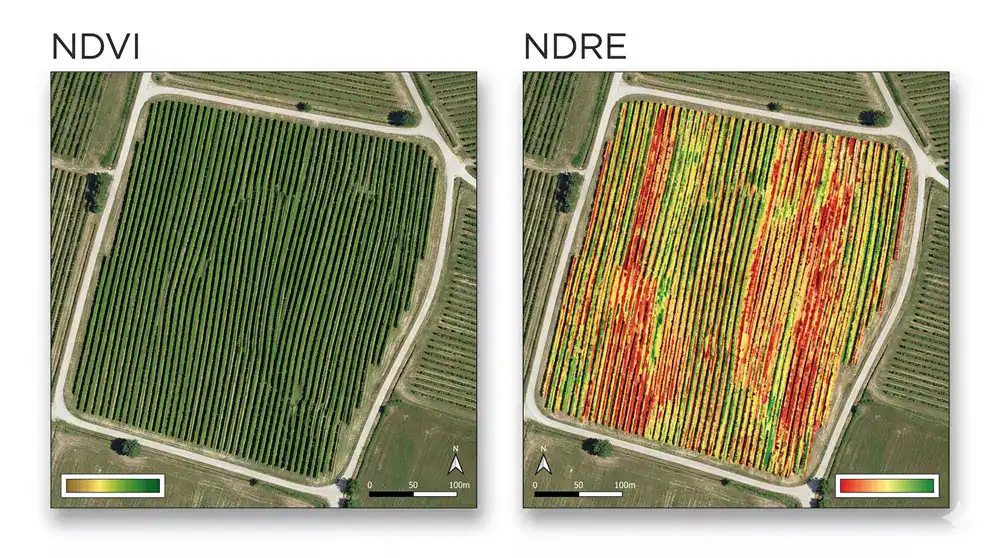
Fig.3: NDVI/NDRE comparison on the same plot: the NDRE map preserves internal variability even where NDVI saturates.
Applications in viticulture and olive growing
In high value-added supply chains, NDRE supports three operational decisions: selective harvest ing (mapping vigors at veraison and dividing the harvest into homogeneous plots), nitrogen management (calibrating fertilizer interventions to really different zones), andidentification of localized stresses (deficiencies, pest attacks, root problems). Experiences documented in case studies and Agrobit work on maps and models to support grape growers show how the NDVI+NDRE combination improves the quality of operational choices compared to visual data alone.
GNDVI, MCARI and TCARI/OSAVI: the chlorophyll indices.
In addition to the NDVI/NDRE duo, there are more specific indices built to isolate precise spectral contributions and reduce soil or leaf cover noise. The main ones are GNDVI, MCARI and the TCARI/OSAVI ratio: they meet fine diagnostic needs and are often used in combination to interpret the physiological state of the crop.
GNDVI: the sensitivity to green
Green NDVI ( GNDVI ) replaces the red band with the green band: GNDVI = (R_NIR – R_Green) / (R_NIR + R_Green). It is more correlated with foliar chlorophyll concentration than the classical NDVI and is therefore suitable for reading nutritional states, particularly nitrogen deficiencies at advanced stages. Studies show a good correlation between GNDVI and foliar nitrogen content on straw cereals and maize.
MCARI and TCARI/OSAVI: chlorophyll without soil disturbance
The Modified Chlorophyll Absorption Ratio Index (MCARI ) and the TCARI/OSAVI ratio are chlorophyll indices designed to minimize the effect of bare soil and canopy structure. They are useful in olive groves, wide-row orchards and in the early stages of annual crop development, when leaf cover is partial and “classical” indices are strongly affected by background.
CWSI and water stress indices
When the question is “how much water is the crop lacking,” classical vegetation indices are not enough: the thermal band is needed. The Crop Water Stress Index ( CWSI ) compares canopy temperature with well-watered and maximum-stress reference air and temperatures, returning a value between 0 (no stress) and 1 (maximum stress). It is the cornerstone index of precision irrigation, particularly useful in olive groves and vineyards where controlled water deficit is a quality lever.
How to acquire indexes: smartphone, drone, satellite
Vegetation indices can be obtained from various digital platforms, each with a trade-off between cost, resolution and frequency. The choice depends on farm size, unit value of the crop, and agronomic demand.
- Satellite (Sentinel-2, Landsat): free, global coverage, 10-30 m resolution, 5-day revisit (cloud-free). Ideal for seasonal monitoring at plot scale and for cereals, but limited by cloud cover and resolution on rows in tree crops (high soil presence and inter-row).
- Multispectral/thermal drone: 1-10 cm resolution, on-demand, highest quality data but professional service. It is the platform of choice for vineyards, orchards, olive groves and early phenological stages in cereal/horticulture crops.
- Smartphone: high resolution at plant level, point reading via RGB camera with algorithms, low cost, daily frequency. Ideal for agronomic scouting and small-to-medium farms.
In the Agrobit ecosystem, the three platforms coexist: drone surveys iDrone for high-precision maps, the app iAgro for smartphone monitoring but with Sentinel-2 satellite data also integrated.
Translating indices into concrete agronomic actions
An index map has value only if it becomes a decision. The standard operational flow involves four steps: acquisition of the multispectral data, calculation of the chosen index, zoning into homogeneous classes (typically 2-5 vigor zones), translation into a prescription map for the operating machine. The most frequent applications in Italy today are five.
Fig.4: From map to action: reading NDVI, NDRE and GNDVI in the field means translating them into concrete crop operations.
Differentiated fertilization and nitrogen at variable rates
In arable crops and orchards, zoning on NDVI or GNDVI allows nitrogen to be distributed in proportion to the actual needs of each zone. Various ISMEA analyses indicate nitrogen savings in the range of 10-20% on areas managed at variable rates, with reduced leaching and compliance benefits with CAP 2023-2027 eco-schemes and the Nitrates Directive.
Harvesting and selective harvesting
On PDO and PGI supply chains, NDVI or NDRE pre-harvest maps allow the vineyard to be divided into zones of different vegetative-productive balance and grapes destined for different product lines to be harvested separately. In this regard, you can learn more in the following article where you can see the advantages in a real case.
Targeted pest management
Identifying localized abnormalities (disease outbreaks, insect attacks, root problems) allows intervention only where it is needed. Combined with prescription maps and sprayer drones, selective defense can reduce pesticide use in line with the goals of the European Farm to Fork strategy and the Agri 4.0 NRP.
Precision irrigation
Integration of CWSI maps from thermal flight, soil moisture probes, and local weather stations enables construction of zonal irrigation plans. Especially relevant in regions of increasing climate stress.
Reporting for certified supply chains
Cooperatives and social wineries use the historical map archive as technical documentation for PDO/PGI specifications, sustainability schemes (SQNPI, Equalitas, VIVA) and corporate sustainability reports, in line with the CSRD directive and the European Green Deal.
Frequently asked questions about vegetation indices
What is the difference between NDVI and NDRE?
NDVI uses the red band, NDRE the red edge band. The practical difference lies in sensitivity: the NDVI saturates on dense canopies (LAI greater than 3), while the NDRE preserves internal variability even at late stages of development. For pre-spreading cereals, vineyards in full vegetation and mature orchards, NDRE is almost always more informative.
Which index is best for the vineyard?
There is no one-size-fits-all index: in early vegetative stages (up to flowering) NDVI is adequate; after fruit set and especially in pre-harvest, NDRE is appropriate to avoid saturation. For controlled water stress, especially on premium dies, CWSI from thermal banding is irreplaceable. However, it is always essential to remove the soil and inter-row before proceeding to create zoning and prescription maps, to avoid including pixels that are not of the canopy alone and thus would distort the final value leading also to false positives/negatives.
Can vegetation indices be calculated with a smartphone?
Yes, in direct mode only for indexes based on visible bands and with proprietary calibration algorithms. DSS apps such as iAgro generate vigor maps (LAI index) from RGB photos and also process indices from Sentinel-2 bands in the cloud. Resolution and accuracy are lower than a multispectral drone survey, but the cost/benefit ratio is excellent for scouting and small-to-medium scale.
What does an NDVI of 0.7 mean?
Indicates a healthy crop with good leaf cover and high photosynthetic activity. Exact interpretation depends on species, phenological stage, geography and sensor: 0.7 in a vineyard in May means different things than 0.7 in a cereal in July. Credible comparisons are made between areas on the same farm in the same flight, not absolutely.
How often should an NDVI map be updated in season?
For Sentinel-2 satellite monitoring, the natural cadence is 5 days, reduced by cloud cover. For drone surveys on high-value supply chains, at least 1-2 seasonal flights are recommended at key phenological stages (fruit set, veraison, pre-harvest), which can be increased to 6-8 in experimental or research regimes.
What regulations incentivize the use of vegetation indices?
At the European level, the Green Deal’s Farm to Fork strategy aims for -50% pesticide and -20% fertilizer use by 2030; in Italy, the 2023-2027 CAP with enhanced cross-compliance and eco-schemes rewards precision farming practices. PNRR Agri 4.0 and regional RDPs fund remote sensing hardware, software and services.
Do you want to turn vegetation indices into operational decisions?
Agrobit designs integrated remote sensing plans for your supply chain: multispectral and thermal drone surveys with iDrone, continuous monitoring via iAgro app, integration with field and management sensors. Talk to one of our engineers to build the right flow for your business.
▶ Learn about the iDrone service ▶ Learn more about the Agrobit blog.
For agronomists and field technicians a training course dedicated toprecision agriculture and photogrammetry is also available.