

by Antonio Donnangelo
Share

Vineyard monitoring and analysis with smartphone app
Introduction
In the wine industry, precision and accuracy in vineyard management are crucial to achieving high quality production. However, traditional practices of measuring plant vigor, such as the use of manual or visual methods to assess canopy thickness and height, can lead to subjective and inaccurate results. This approach not only compromises precision in vineyard management, but can also lead to excessive use of pesticides, with negative consequences for the environment and production costs.
To address this challenge, iAgro, an innovative application designed to objectively and scientifically characterize the vegetative development of each plant, was developed . iAgro offers agricultural technicians and winegrowers a reliable and efficient alternative to manual measurement, providing optimized data to calibrate sprayers for pesticide distribution. In addition to improving accuracy in the application of plant protection treatments, the data collected by iAgro also enables informed decisions about overall vineyard management, including fertilization and grape harvest scheduling.
Using the iAgro app in the vineyard.
The case study under consideration focuses on a test vineyard at a major Chianti Classico winery.
During the 2023 vintage, a survey was performed through the use of the iAgro app to characterize the vigor of a vineyard of about 5 ha and to generate a prescription map in two classes for differentiated phytosanitary treatments (Fig. 1). The test was performed on May 30, 2023, during the phenological flowering stage, sampling 15 plants.
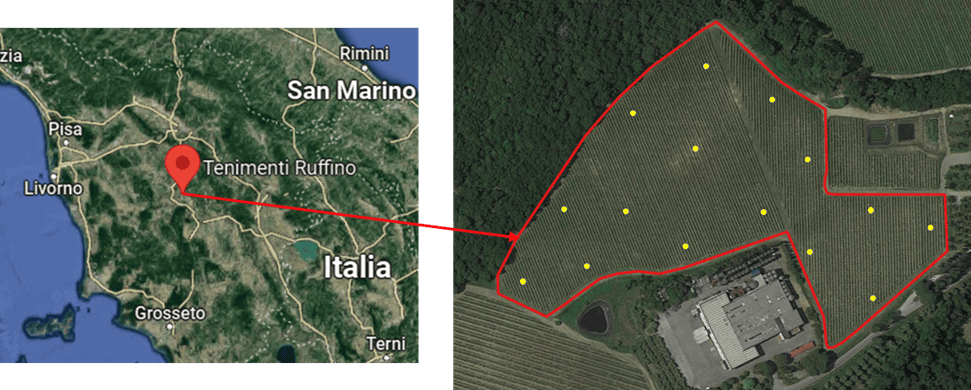
Fig.1: Location of the test vineyard.
With iAgro, by rapid photographic scanning to all sample plants, it was possible to generate the relative 3D model (digital twin) (Fig. 2) and quickly and objectively measure several parameters, namely:
the height, thickness and volume
of the scanned floor plan;- the Leaf Area Index (LAI);
- the Leaf Wall Area (LWA);
- the Tree Row Volume (TRV);
- The optimal dose of water for plant protection treatments.

Fig.2: 3D reconstruction of a sample floor plan generated by the app.
By sampling a sufficient number of well-distributed plants in the field, the app automatically generated maps of vegetative vigor (LAI index), which were then used to generate a prescription map for variable and optimized phytosanitary treatments based on actual vineyard needs (Fig. 4 and Fig. 5).

Fig.3: Vigor map (LAI) generated by the app and can be used to optimize fertilization and harvesting.

Fig.3: Prescription map generated by the app for optimized plant protection treatments.
Based on the disease to be combated (e.g., downy mildew) and the farm sprayer, the app is able to suggest the correct dose of water and agrochemical to be distributed, always respecting the manufacturer’s label.
During the case study, thanks to iAgro it was possible to save 73 percent of water compared to the farm doses and to better distribute agrochemicals. This not only represents a significant saving in water resources, but also demonstrates a tangible advantage in optimizing the use of pesticides, improving product distribution in areas where there is the greatest need.
Conclusions
With iAgro, digital agriculture joins the wine-growing tradition, enabling a management that is more efficient, sustainable and based on objective data. The app is intended to be a tool to promote smart and environmentally friendly agricultural practices, aiming to improve the quality and profitability of wine production.
With an innovative tool such as iAgro, not only is improved vineyard management achieved, but it also opens the door to further developments that directly involve the end consumer. For example, through a dedicated company page, it would be possible to show in a transparent and engaging way what happens in the field during each vintage, thus improving the company’s image in the eyes of consumers.
Data collected in the field could be used for marketing purposes, providing the consumer with detailed information about the production process, seasonal weather patterns and more, going on to add value to the product, creating a deeper connection between the company and the consumer.
For more information on how the app works, you can consult
the dedicated section
on the website or watch the video tutorial.